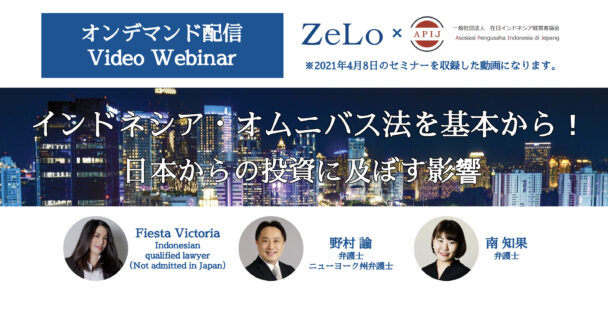

インドネシアが「外国公文書の認証を不要とする条約」を批准

Attorney admitted in Japan and NY
Satoshi Nomura

Attorney-at-law admitted in Indonesia
Fiesta Victoria

Indonesia has long required foreign documents to undergo a lengthy legalization process before they can be used for business, court, or administrative purposes. On January 4, 2021, Indonesia ratified the Apostille Convention, significantly simplifying this process by allowing the use of apostille certificates for eligible documents from contracting states.

Fiesta Victoria is an Indonesian qualified lawyer with over 16 years of experience in M&A and general corporate. She graduated from the University of Pelita Harapan in 2006 and started her career as a lawyer in the same year at one of the largest and oldest law firms in Indonesia. She joined ZeLo in 2019 with the primary role of establishing and developing ZeLo’s Indonesian practice group. She won the title of "Business Development Lawyer of the Year" at the ALB Women in Law Awards 2021. Additionally, she was nominated as one of the top 5 finalists for "Foreign Lawyer of the Year" at the ALB Japan Law Awards 2023, following a nomination in the same category at the ALB Japan Law Awards 2022.
Indonesia is one of the countries that requires a legalization process for foreign documents (that is, documents signed in countries outside Indonesia) before such documents can be admitted or used, either for business purposes, in court proceedings, or for administrative filings with the government, in Indonesia.
On January 4, 2021, Indonesia ratified the Convention to Abolish the Requirement for Legalization of Foreign Public Documents (the “Convention”) through Presidential Regulation No. 2 of 2021 on the Ratification of the Convention Abolishing the Requirement of Legalization for Foreign Public Documents.
This ratification is intended to simplify the legalization process for foreign documents, which is known to be time-consuming. Currently, there are several steps that a party must follow in order to legalize a foreign document, including authentication by the relevant institutions or ministries in the country of origin or destination, as applicable.
With ratification of the Convention, a party is required only to obtain an apostille certificate from the authorized apostille certificate issuing authority in the country of origin , to the extent that such country is a contracting state to the Apostille Convention and the document is one of the categories recognized under the scope of Indonesia’s ratification.
According to the status table[1] as of 15 September 2026, there are currently 130 contracting countries of the Convention.
The Convention applies to “public documents,” which are as follows:
One of the most commonly used documents in businesses, court proceedings, and licensing applications is a power of attorney. One question now is whether a power of attorney signed by a party outside Indonesia can be exempted from the legalization process requirements.
Legal experts and practitioners have shared different views on this question. Some experts argue that a power of attorney is a private document, and therefore does not fall within any of the above “public documents” categories. Another view is that “when the signature in a private document is authenticated by a notary official, then the notarial authentication in that private document is considered to be an official certificate that constitutes a ‘public document.’[3]
Note that the following documents are not exempted from the legalization process requirements:
The treatment of a given foreign document, including in this context a power of attorney signed outside Indonesia will depend on many factors, such as how the document is categorized and treated in the country of origin, as well as the acceptance and admissibility of the foreign document by the respective institution / court where such document will be used. The current accepted business practice is for a PoA signed in one of the contracting states of the Convention to be apostilled before being used in Indonesia.
For further information on the above, please contact this form.
[1] https://www.hcch.net/en/instruments/conventions/status-table/?cid=41
[2] Article 1 of the Convention.
The information provided in this article does not, and is not intended to, constitute legal advice and is for general informational purposes only. Readers of this article should contact an attorney to obtain advice with respect to any particular legal matter.
Attorney admitted in Japan and NY
Satoshi Nomura
Attorney-at-law admitted in Indonesia
Fiesta Victoria
Attorney admitted in Japan and NY
Satoshi Nomura
Attorney-at-law admitted in Indonesia
Fiesta Victoria

Attorney-at-law admitted in Indonesia
Fiesta Victoria
Attorney admitted in Japan and NY
Satoshi Nomura
Attorney-at-law admitted in Indonesia
Fiesta Victoria
Attorney admitted in Japan
Chika Minami

Attorney admitted in Japan and NY
Satoshi Nomura
Attorney-at-law admitted in Indonesia
Fiesta Victoria
Attorney admitted in Japan
Chika Minami