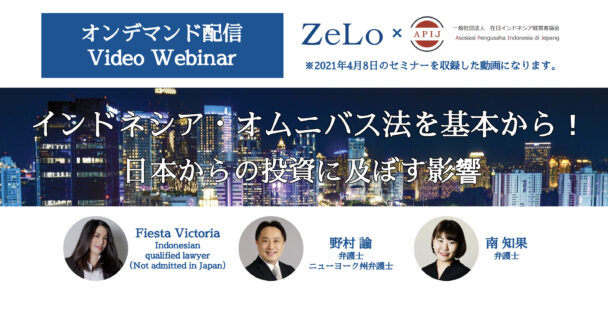

インドネシアが「外国公文書の認証を不要とする条約」を批准

Attorney admitted in Japan and NY
Satoshi Nomura

Attorney-at-law admitted in Indonesia
Fiesta Victoria

Indonesia is advancing the digitalization of its land administration system through the introduction of electronic land registration and electronic land certificates. To support this transition, Regulation No. 3 of 2023 establishes a more comprehensive framework governing the issuance, management, and authentication of electronic documents used in land registration activities. The regulation also expands the scope of electronic land administration by enabling changes to land registration data to be recorded electronically. This article outlines the key features of Indonesia’s electronic land registration framework and the regulatory developments introduced under Regulation No. 3 of 2023.

Fiesta Victoria is an Indonesian qualified lawyer with over 16 years of experience in M&A and general corporate. She graduated from the University of Pelita Harapan in 2006 and started her career as a lawyer in the same year at one of the largest and oldest law firms in Indonesia. She joined ZeLo in 2019 with the primary role of establishing and developing ZeLo’s Indonesian practice group. She won the title of "Business Development Lawyer of the Year" at the ALB Women in Law Awards 2021. Additionally, she was nominated as one of the top 5 finalists for "Foreign Lawyer of the Year" at the ALB Japan Law Awards 2023, following a nomination in the same category at the ALB Japan Law Awards 2022.
A secure and efficient land registration system is fundamental to ensuring legal certainty over land rights and fostering public confidence in property ownership. In response to technological advancements and the increasing demand for digital public services, Indonesia has embarked on a broader reform of its land administration system by gradually transitioning from conventional paper-based land certificates to electronic land certificates. This reform is particularly significant given the longstanding challenges faced by Indonesia's land registration system, which has historically been susceptible to corruption, administrative inefficiencies, and criminal activities, including the forgery of land certificates. These issues have undermined legal certainty, given rise to frequent land disputes, and, at times, discouraged foreign investment by creating uncertainty over land ownership and transactions.
Recognizing these challenges, the Government has pursued the digitalization of land registration as part of its broader e-government and bureaucratic reform initiatives. The objective is not merely to replace physical certificates with electronic versions but to modernize the entire land registration process through the adoption of an integrated electronic system capable of improving efficiency, transparency, and legal certainty.
To support Indonesia's digital transformation of land administration, the Ministry of Agrarian Affairs and Spatial Planning/Head of the National Land Agency ("ATR/BPN") issued Minister of Agrarian Affairs and Spatial Planning/Head of the National Land Agency Regulation No. 3 of 2023 on the Issuance of Electronic Documents in Land Registration Activities ("Regulation No. 3 of 2023"), which came into force on 20 June 2023 and revoked Minister of Agrarian Affairs and Spatial Planning/Head of the National Land Agency Regulation No. 1 of 2021 on Electronic Land Certificates ("Regulation No. 1 of 2021").
Although Regulation No. 1 of 2021 had already established the legal foundation for electronic land certificates, including their issuance mechanism, conversion of physical land certificates into electronic form, and recognition as valid evidence of land rights, its implementation highlighted the need for further regulatory refinement to address practical and administrative challenges arising from the transition toward digital land administration.
Before Regulation No. 1 of 2021 was issued, the digitization process at BPN had progressed only partially. Since 2020, BPN has made available several online land-related services: (i) electronic mortgage (Hak Tanggungan) registration; (ii) issuance of land registration clearance letters (Surat Keterangan Pendaftaran Tanah / SKPT) - this letter is normally required in a land due diligence process conducted before a party would engage in in transactions involving land; and (iii) the provision of information on land values through the land-value zone (ZNT) mechanism.
Viewed from a broader policy perspective, Regulation No. 3 of 2023 represents more than a technical amendment to its predecessor. It reflects a fundamental shift in Indonesia's approach to land administration by establishing a more comprehensive legal framework for electronic land registration. The regulation seeks to improve administrative efficiency, strengthen legal certainty, enhance transparency, reduce opportunities for fraud and document forgery, and improve the overall reliability of Indonesia's land registration system.
Regulation No. 3 of 2023 provides greater detail regarding the implementation of electronic land administration, including:
The emphasis is therefore more operational rather than conceptual.
Accordingly, Regulation No. 3 of 2023 provides the legal foundation for the continued digitalization of land administration in Indonesia and is expected to contribute to a more transparent, efficient, and investment-friendly land registration regime.
Similar with Regulation No. 1 of 2021, the goal is to conduct all future land registration processes electronically. Eventually, all data and land-related documents, such as scale diagrams (gambar ukur), land parcel maps (peta bidang tanah), spatial maps (peta ruang), and ELCs, will be processed and recorded electronically.
Under Regulation No. 1 of 2021, once the online land registration process is completed, ELCs will be issued to record the land titles, ownership, mortgage (hak tanggungan), or grant/waqf (land bequeathed or donated for charitable purposes under Islamic law).
One of the areas further regulated under Regulation No. 3 of 2023 is the recording of changes to land registration data (pencatatan perubahan Data Pendaftaran Tanah). This reflects a broader approach compared to merely regulating the issuance of electronic land certificates, as electronic land administration must also accommodate subsequent changes affecting registered land rights and related legal information.
Under Regulation No. 3 of 2023, changes to land registration data may include, among others, the recording of blocks, seizures, or land-related disputes, the removal of such records, abandoned land status, status quo or suspension status, the recording of sale and purchase binding agreements (Perjanjian Pengikatan Jual Beli) or lease agreements, changes to commodities relating to cultivation rights (Hak Guna Usaha), the recording of the extinguishment of land rights, and other relevant changes.
Such changes are recorded electronically in the electronic land book (Buku Tanah Elektronik or "BT-el") relating to management rights (hak pengelolaan), land rights (hak atas tanah), or ownership rights over apartment units (hak milik atas satuan rumah susun). The recording is made through the creation of a new data block (Blok Data) within the electronic land book, which is subsequently validated through an electronic approval page signed using an Electronic Signature by the authorized official or appointed official.
Importantly, the regulation provides that the recording of changes in the electronic land book does not result in the issuance of a new edition of the electronic land certificate (Sertipikat-el). Instead, the updated information is reflected within the electronic land registration system. Each recorded change must also be notified to the relevant rights holder or nazhir (manager of waqf land) through the Electronic System.
This mechanism demonstrates that Regulation No. 3 of 2023 seeks to establish a dynamic electronic land administration system capable of continuously updating land registration information, rather than treating the electronic certificate as a static replacement for its physical counterpart. By enabling electronic recording of legal events affecting land rights, the regulation aims to improve the accuracy, transparency, and reliability of land registration data.
For further information on the above, please contact this form.
The information provided in this article does not, and is not intended to, constitute legal advice and is for general informational purposes only. Readers of this article should contact an attorney to obtain advice with respect to any particular legal matter.
Attorney admitted in Japan and NY
Satoshi Nomura
Attorney-at-law admitted in Indonesia
Fiesta Victoria
Attorney-at-law admitted in Indonesia
Fiesta Victoria
Attorney admitted in Japan and NY
Satoshi Nomura
Attorney-at-law admitted in Indonesia
Fiesta Victoria

Attorney admitted in Japan and NY
Satoshi Nomura
Attorney-at-law admitted in Indonesia
Fiesta Victoria
Attorney admitted in Japan
Chika Minami

Attorney admitted in Japan and NY
Satoshi Nomura
Attorney-at-law admitted in Indonesia
Fiesta Victoria
Attorney admitted in Japan
Chika Minami